Home / Mario
Super Mario Bros. · solo from the screen
One Cadence brain beat all of World 1 in a single 5-life gauntlet
Brain W1b ("the balanced finisher", trained overnight 10/31) cleared 1-1, 1-2, 1-3 and 1-4 (Bowser) back to back with the same weights, losing three lives on 1-3, then ran out on 2-1, a level it never trained on. On 50 held-out starts per level it clears 1-1 7, 1-2 8, 1-3 9 and 1-4 27 times: every level, none consistently yet. Other brains still do better on single levels (1-1 50/50 with W1_F2ck110, 1-4 50/50). Every button in every clip is the brain's.
Latest (11/16): Fabius (recall memory plus prediction slots) does not beat Cato2, the same brain without them: 920.8 against 958.0 mean x at chunks 81 to 100, a gap of -37 inside the 65 between Cato2's own two seeds. With two seeds per brain they can't be told apart; if anything the point estimate leans toward Cato2. Details. Scipio (11/14 to 11/15), a slow memory aimed at the stalls where Mario holds one button against a wall, did not change the stalls (the read). A likely reason, found after the read: a tie rule in the teaching labelled most of the 4-2 start stalls, and the 2-2 stall we checked, as correct. 4-4 is a different case. The next brain, Marcellus, started 11/16 to test this (details). In the public gauntlet two Scipio brains cleared 1-1 at chunk 50; none has passed 1-2. The goal is World 8, the final world: never coached, learned by own play only, cleared with at most 1 death in total. The goal.
W1b's run
- 1-1cleared, first try
- 1-2cleared, first try
- 1-3cleared on the fourth trydeaths at x 747, 1,200, 1,202
- 1-4cleared, first try (Bowser)
- 2-1last two lives lostx 343, 346; never trained on
Held-out clears, out of 50 starts each:
Last updated 2026-11-16 07:00 EST. Fabius and Cato2 trained on Cadence 0.95.0, the Scipio and Marcellus brains on 0.99.0. Older brains trained on Cadence (cadence-net) 0.91.1 and re-scored on 0.91.3: identical answers, identical scores. The 10/31 overnight brains trained on 0.91.3. Cadence is by Pragma Research; this experiment is independent.
The goal: World 8, never coached
Clear all four World 8 levels with at most 1 death in total
World 8 is the final world. No brain is ever coached on it or trained with a coach's labels there: whatever it learns on World 8 it learns by its own play. The gate is 8-1 to 8-4 cleared with at most one death across all four levels. The plan coaches worlds 1 to 7. (Until 11/6 the exam was World 4, and before that World 2.) Nothing on this page has played World 8 yet. So far Fabius, Cato2 and Scipio are coached on worlds 1 to 6 (24 levels), with World 7 held out as a development check.
The coach is verified on worlds 1 to 7: 164 of 168 test runs (6 starts per level) reach the flag, 11/8, assembled from six runs at the current settings (not one fresh pass). Worlds 1 to 3 72 of 72; worlds 4 to 7 92 of 96. Only 5-3 and 6-3 are short, 4 of 6 each (long leaps off high lifts). COACH.md. Planning lives in GitHub issues: #1 roadmap, #2 World 8, #4 plateau test, #11 Fabius vs Cato2, #12 Scipio, #13 Marcellus.
Scipio (11/14 to 11/15): does a slow memory fix the stalls?
No. The slow memory did not change the stalls (registered read at chunk 50). A likely reason, found after the read, is in the teaching.
Sean's question: is memory the answer to the holding problem? In the Fabius study every stuck attempt we checked (no new furthest x for 15 s; 108 attempts from Cato2 A and B at chunk 100 and Fabius A at chunk 65) held one button for its last 100+ decisions. On a pipe the screen looks the same on decision 5 and decision 150, so a brain that sees only the present can't tell it has been pushing against the same wall for seconds. Earlier memory tests could not catch this: Cicero's button memory faded within about 5 decisions, and the plateau test scored distance only.
- ScipioA / ScipioB: a slow screen memory and a slow button memory, both fading at 0.97 per decision (about 2 s).
- ScipioFast: the same parts, fading at 0.8 (well under a second).
- Twin: the same brain with no memory, the control.
All four: Cadence 0.99.0, Cato2's exact eyes (including the colour close-up placed from Mario's position in the game's memory), 256 neurons, 7 buttons, coached on worlds 1 to 6 with the coach labelling stalls up to 100 decisions, scored every 2nd chunk, stop at chunk 50. Registered before launch (11/14): the main number is stuck attempts per 192 practice attempts (8 starts on each of 24 levels), averaged over the last 10 scored chunks, with the 24-level mean x as a guard. The verdict also needs a time-only test on the same checkpoint: the memories cut to hold only the previous moment, so a change in stalls is pinned on how long the memory lasts, not on removing an input. ScipioA started 11/14 03:01, the others 05:44 to 05:46. Issue #12.
The read (11/16)
| run | stuck of 192 | never left the start | deaths of 192 | flags of 192 | 24-level mean x |
|---|---|---|---|---|---|
| ScipioA (slow memory) | 44.4 | 14.8 | 147.2 | 0.4 | 807 |
| ScipioB (slow memory) | 37.3 | 14.3 | 153.4 | 1.3 | 837 |
| Twin (no memory, control) | 45.5 | 14.1 | 145.0 | 1.5 | 827 |
| ScipioFast (fast memory, one seed) | 25.0 | 0.0 | 166.2 | 0.8 | 884 |
Means over the last 10 scored chunks (32 to 50), 8 practice starts on each of 24 levels. Registered rules: the memory brains had to beat Twin by more than 10 stuck attempts, and a time-only test (each memory cut to hold only the previous moment, same strength) had to raise their stuck count by more than 10. Neither happened: ScipioA sits 1.1 below Twin and ScipioB 8.2 below, and the time-only test changed stuck by -6.7 (A) and +9.3 (B), the mean over chunks 46, 48 and 50 (per chunk A -14, -16, +10; B +13, 0, +15). The test passed its own check (agreement with the coach fell 0.04, under the 0.05 limit), and the untouched brains replayed every one of their 192 attempts exactly as in training. Verdict: the memory was not used on stalls (this test cannot tell "not used" from "useless"). The time-only cut did cost distance (47 to 402 mean x by checkpoint), but switching the memories off entirely cost less on average (A 157 against 72, B 203 against 40), so that loss reads as a disturbance, not as the memory helping. ScipioFast's lead is mostly in starts it never stood at (4-2 and 4-4); under the time-only test its stuck count rose 13.7 (unregistered, one seed, no verdict).
What was actually holding them
- The coach can get out (one brain, five stalls). Put in ScipioA's own stalls (2-2 underwater, the 4-2 and 4-4 starts), the coach escaped 5 of 5 within 9 to 35 decisions.
- The teaching said "keep doing that". When the brain stalls, the coach labels its last 100 decisions (DAgger). A tie rule in that labeller kept the brain's own button whenever it scored within 2 pixels of the coach's best plan. Standing still at the start of 4-2 then jumping scores 165 pixels; jumping now scores 167. So nearly every frame of a 4-2 start stall was labelled "stand still" (998 to 1,098 of every 1,000 to 1,100 labels in each run that stood there); most of those came from the tie rule, the rest are the coach's own (it waits on about 38 of 100 frames at the training start). On 2-2 the held "run" was labelled correct 15 of 15 times on the stall we checked.
- For the slow-memory brains, start stalls are set in the first decisions, before any memory has anything in it (the time-only test left their start stalls almost unchanged; ScipioFast is the exception, it gained 8 at two checkpoints). A plain network trained on the coach's own runs never stands at a start; add Cato2A's DAgger rows and it gets stuck at 4-4 on all 8 starts, on four seeds.
These three were found after the registered read, so they likely explain it; they are not part of it. At the 4-4 training start the coach itself waits on about half the frames, so 4-4 is not a tie-rule stall. Details: issue #12.
Marcellus (since 11/16): clean labels on stalls
The next brain is Twin with one change: in a stall (10 decisions without progress) and before the first step forward, the coach's own label stands; the tie rule only applies while the brain is moving. Two seeds, each paired with a control that differs by that rule alone (MarcellusA starts from Twin's exact brain; MarcellusB and the new TwinB share seed 1). Registered before launch: stuck per 192 over the last 10 scored chunks at chunk 50; "labels help stalls" if both pairs beat their control by more than 10. My prediction, written down before launch: 4-2 stalls go to about 0, 2-2 drops but not to 0, and the main number passes but only just. Memory comes back after this, on the clean labels, with two seeds. Issue #13.
Public gauntlet (every 10 chunks)
Sean's idea: every 10 chunks each Scipio brain gets 10 lives in total to play the game from 1-1 in order. Greedy, no learning, a flag moves on to the next level, a death or 15 s without progress costs a life. It stops after 7-4, so World 8 stays unseen. This is for this page only and never decides anything; the registered numbers are in the Scipio section above. Different rules from the older five-life gauntlets further down.
| chunk | brain | furthest | levels cleared | lives used | clip |
|---|---|---|---|---|---|
| 50 (11/15 10:49) | ScipioA | 1-2, x 973 | 1-1 | 10 of 10 | clip |
| 50 (11/15 14:50) | ScipioB | 1-2, x 903 | 1-1 | 10 of 10 | - |
| 50 (11/15 12:49) | Twin | 1-1, x 901 | none | 10 of 10 | - |
| 50 (11/15 09:39) | ScipioFast | 1-1, x 898 | none | 10 of 10 | - |
| 40 (11/15 09:21) | ScipioB | 1-2, x 1,190 | 1-1 | 10 of 10 | clip |
| 40 (11/15 05:09) | ScipioFast | 1-2, x 945 | 1-1 | 10 of 10 | - |
| 40 (11/15 05:31) | ScipioA | 1-1, x 2,757 | none | 10 of 10 | - |
| 40 (11/15 07:01) | Twin | 1-1, x 898 | none | 10 of 10 | - |
| 30 (11/14 22:39) | ScipioFast | 1-1, x 723 | none | 10 of 10 | - |
| 30 (11/14 22:10) | ScipioA | 1-1, x 596 | none | 10 of 10 | clip |
| 30 (11/15 01:59) | ScipioB | 1-1, x 434 | none | 10 of 10 | - |
| 30 (11/15 00:07) | Twin | 1-1, x 315 | none | 10 of 10 | - |
| 20 (11/14 18:07) | ScipioFast | 1-1, x 2,386 | none | 10 of 10 | clip |
| 20 (11/14 19:46) | ScipioB | 1-1, x 1,789 | none | 10 of 10 | - |
| 20 (11/14 16:36) | ScipioA | 1-1, x 1,433 | none | 10 of 10 | - |
| 20 (11/14 19:27) | Twin | 1-1, x 899 | none | 10 of 10 | - |
| 10 (11/14 11:46) | ScipioA | 1-1, x 315 | none | 10 of 10 | clip |
| 10 (11/14 11:47) | ScipioB | 1-1, x 315 | none | 10 of 10 | - |
| 10 (11/14 11:47) | ScipioFast | 1-1, x 315 | none | 10 of 10 | - |
| 10 (11/14 11:48) | Twin | 1-1, x 315 | none | 10 of 10 | - |
All four brains played the same way at chunk 10: every life ended at x 312 to 315 on 1-1, about two seconds in. Their practice scores on 1-1 say the same (mean x 314 on all 8 starts). Each chunk-10 checkpoint had about 5 to 6 hours of training. At chunk 20 (11/14 afternoon and evening) all four still spent their 10 lives on 1-1, but got further: furthest x 2,386 (ScipioFast), 1,789 (ScipioB), 1,433 (ScipioA), 899 (Twin). One gauntlet per brain is a public look, not a test; these numbers decide nothing.
Chunk 30 went backwards for the three memory brains: every one of their lives on 1-1 ended standing still (15 s without progress, x 434 to 723), and Twin died 10 times at x 315. At chunk 40 ScipioB and ScipioFast cleared 1-1 for the first time in a gauntlet and died on 1-2; ScipioA got to x 2,757 on 1-1 without the flag. At chunk 50 (the last checkpoint) ScipioA and ScipioB cleared 1-1 and died on 1-2; ScipioFast and Twin spent all 10 lives on 1-1. No brain has passed 1-2. One gauntlet per brain is a public look; it swings from round to round and decides nothing.
Fabius vs Cato2 (11/8 to 11/14): recall memory plus prediction
Short answer: Fabius does not beat Cato2. With two seeds each they can't be told apart.
Fabius A/B: 3,536 inputs (body sense, a grey view of the whole screen, a colour close-up around Mario; the close-up is placed using Mario's position read from the game's memory, but the brain gets only its pixels, never the position numbers), a recall memory and 104 prediction slots, Cadence 0.95.0. Cato2 A/B: the same eyes and the same teaching, with recall off and no prediction slots. Both coached on worlds 1 to 6 (24 levels), 15 s stuck limit. Registered before launch (11/8): one number per run, the 24-level mean x on 8 practice starts per level, averaged over chunks 81 to 100. Fabius wins only if it beats Cato2 by more than the larger gap between two seeds of one brain.
| run | mean x, chunks 81 to 100 | flags, of 3,840 attempts |
|---|---|---|
| Cato2 A (control) | 990.4 | 69 |
| Cato2 B (control) | 925.6 | 84 |
| Fabius A | 905.8 | 19 |
| Fabius B | 935.7 | 40 |
- Fabius vs Cato2: 920.8 against 958.0, a difference of -37. The larger seed gap is Cato2's, 65. Not distinguishable; the registered test fails. The point estimate leans toward Cato2.
- Flags (not registered): Fabius 59, Cato2 153, of 7,680 practice attempts per brain type (3,840 per run: 20 chunks x 192). 84 of Cato2's are on 4-1 alone.
Also not registered: both Cato2 seeds stand still on 4-4 at every chunk from 81 to 100. Deviation: the registered chunk-25 recall check (recall switched off against on) was not run on time; it ran late on 11/14 and passed (Fabius A on 817 / off 302, Fabius B on 638 / off 250, floor 242, the Cato2 seed gap on the same 6 levels at chunk 25). Switching recall off removes a whole input, so this shows the brains lean on that input, not that they use it as memory. The chunk-10 check passed on time (Fabius A on 374 / off 307, Fabius B on 772 / off 314, floor 288). Practice starts only; none of these brains has been scored on held-out starts. Fabius A and Cato2 A ran on, unregistered, to about chunks 112 and 116 (not read); then all four were stopped. Issue #11.
Plateau test (11/5 to 11/6): does memory plateau higher?
Short answer: no verdict either way. None of the three memory recipes plateaus higher, and none plateaus lower.
Sean's hypothesis: brains with and without memory learn at about the same pace, but memory plateaus higher. The six cold-start brains below (Cato, Cicero, Livy, two seeds each) resumed exactly where they stopped and trained on to chunk 200, joined by a new arm, CiceroLow (Cicero with its working memory turned down from 3.0 to 0.3, since Cadence's docs say the strong setting hurts imitation). All 8 runs reached chunk 200.
The test, as written before launch (11/5)
One number per run: the mean over the 12 training levels of the best x on 8 fixed practice starts, averaged over chunks 191 to 200. (This is the 8-start version of the curve in the cold-start section, so it isn't directly comparable to the AUC / END table there.) Noise floor = the biggest gap between the two seeds of one brain type. Memory "plateaus higher" only if BOTH seeds beat Cato's matching seed by more than the floor; "plateaus lower" by the mirror rule; anything else: not distinguishable.
| run | mean best x, chunks 191 to 200 | slope over the last 60 chunks (x per chunk) |
|---|---|---|
| Cato A (control) | 1,160 | -1.0 ± 0.8 |
| Cato B (control) | 1,310 | +1.9 ± 1.1 |
| Cicero A | 1,159 | +1.4 ± 1.0 |
| Cicero B | 1,281 | +1.9 ± 0.9 |
| Livy A | 1,251 | +2.5 ± 1.1 |
| Livy B | 1,138 | +0.9 ± 0.9 |
| CiceroLow A | 1,223 | -0.1 ± 0.9 |
| CiceroLow B | 1,254 | +1.2 ± 0.8 |
- Noise floor: 150.2, the gap between Cato's own two seeds. (Arm gaps: Cicero 122, Livy 113, CiceroLow 31.)
- Cicero vs Cato: -1 / -29 (seed A / seed B): not distinguishable.
- Livy vs Cato: +91 / -172: not distinguishable. Livy B is outside the floor, but Livy A is on the other side, so the both-seeds rule gives no verdict.
- CiceroLow vs Cato: +63 / -56: not distinguishable.
Five of the six seed comparisons are inside the floor. With two seeds per brain this test only sees big effects; a small memory benefit or cost is not ruled out. 6 of 8 curves still slope up slightly at chunk 200 (about +1 to +2.5 x per chunk; only Cicero B and Livy A clearly above noise), so "plateau" is loose. Correction on record: an interim text on 11/6 said "Livy plateaus lower" from a chunk-161 read (floor 51 then); at chunk 200 it is not distinguishable. These runs kept the old stuck limit (2.7 s) by design, since the test was registered with it. Notebook: COLDSTART.md, issue #4.
Cold-start night (11/2 to 11/3): memory from birth, World 4 as the exam (then; since 11/6 the exam is World 8)
Short answer: no difference we can tell apart from luck. World 4 at first sight: 0 clears.
The memory night started from a brain that already played well without memory, so maybe it never needed one. This time six brains started from nothing: Cato (no memory), Cicero (thought + button memory) and Livy (all four memories), two seeds each, memory live from the first lesson. Same coach, same lessons, about 20 hours, trained on all 12 levels of worlds 1 to 3. World 4 was never coached or trained on: it was the exam then. (Since 11/6 the exam is World 8, and World 4 becomes a coached training world.) These six brains continued in the plateau test above.
The test, as written before the night
One number per brain: the practice-start mean x averaged over all 12 training levels, as a learning curve. Compared at equal lessons (chunks 0 to 74, 37,000 lesson batches, the most every run reached). AUC = the area under that curve divided by its length (a mean x over training); END = the value at chunk 74. "Noise" = the biggest gap between the two seeds of one brain type. Memory "helps" only if BOTH seeds beat Cato's matching seed by more than the noise, on BOTH numbers.
| run | AUC (mean x) | END (mean x at chunk 74) | practice flags at 74, of 288 |
|---|---|---|---|
| Cato A (control) | 783 | 979 | 0 |
| Cato B (control) | 801 | 1,091 | 8 |
| Cicero A | 791 | 1,077 | 0 |
| Cicero B | 735 | 927 | 12 |
| Livy A | 720 | 1,119 | 0 |
| Livy B | 738 | 966 | 0 |
- Noise: AUC 56, END 153 (the seed gaps inside one brain type).
- Cicero vs Cato: AUC +7 / -66, END +97 / -164 (seed A / seed B). The seeds disagree in sign: not distinguishable.
- Livy vs Cato: AUC -64 / -63 (both below Cato by a bit more than the noise), END +140 / -125: not distinguishable. Livy was slower on the area by both seeds, but the rule needs both numbers, and END splits.
World 4, first sight (not coached or trained at the time)
| checkpoint | 12 training levels, held-out flags of 600 | 4-1 to 4-3 flags of 150 | 4-1 to 4-3 mean x |
|---|---|---|---|
| Cato A ck74 / ck104 | 7 / 3 | 0 / 0 | 520 / 513 |
| Cato B ck74 / ck84 | 8 / 11 | 0 / 0 | 602 / 751 |
| Cicero A ck74 / ck108 | 1 / 15 | 0 / 0 | 571 / 414 |
| Cicero B ck74 / ck93 | 11 / 18 | 0 / 0 | 412 / 595 |
| Livy A ck74 / ck90 | 3 / 7 | 0 / 0 | 528 / 387 |
| Livy B ck74 (its last) | 6 | 0 | 344 |
Greedy play on 50 held-out starts per level, checkpoints fixed in advance (chunk 74 = equal lessons, and each run's last). The few training-level clears are almost all 1-4, 2-4 and 3-2. 4-4 (the maze castle) is reported separately: every attempt of every brain ends at exactly x 138: the lava pit right after the start. We checked it's a real death, not a bug (a simple scripted jump pattern gets past it), so no brain ever jumps that first pit. Two seeds per brain, fresh brains, about 20 hours: the honest expectation was near-zero clears, and the curves are the result.
Memory night (11/1 to 11/2): does a memory help?
Short answer: not yet. Every pre-registered test lost.
Four brains trained side by side overnight from the same start (W1_F2ck110), same coach, same lessons, same driver, about 13 to 16 hours each. One has no memory (Cato, the control). The others got memory parts that Cadence already has but that our Mario play had never switched on. None of them beat the control by more than the gap between two copies of the control itself, and switching the short-term memory off at play made the best memory brain better, not worse.
How it remembers (plain words)
- Thought memory. A second group of 256 neurons (the "prefrontal") that keeps a fading copy of what the brain was thinking a moment ago, and feeds it back in with the next screen.
- Button memory. Seven neurons that remember which button it pressed and for how long, fading over about five decisions.
- Echo. A fading copy of the last second or so of everything it saw, so it can tell "the enemy is getting closer" apart from one still frame.
- Place memory. A notebook keyed on "where am I": after a death it writes "not that button, here", and next life at the same spot the note votes. Agrippa keys places by the screen; AgrippaX by Mario's x position read from the game (where it is only; decisions still come from the screen).
Every memory brain started as an exact copy of W1_F2ck110 with its memory wires at zero, so on the first chunk all four played identically (checked: same buttons, same scores). Anything different later came from what the memory wires learned.
Top 3 picks: 119, 70, 33 of 200 (mean 74). Scores shown: its first pick, ck20.
memory parts: none · 15 h 47 min
Has a place memory (keyed on x), but the night's recipe never writes to it, so it trained like Cato. Top 3: 85, 64, 60 (mean 70). It measures the noise.
memory parts: Place memory (empty) · 15 h 47 min
Top 3: 88, 97, 61 (mean 82). The brain in the World 1 demo below. With its memory switched off it scores 106.
memory parts: Thought memory, Button memory · about 12 h 55 min, less after a CPU slot jam
Top 3: 43, 65, 56 (mean 55), the lowest. Its weights lean on the memories (all off: 15), but it plays worse than the control.
memory parts: Thought memory, Button memory, Echo, Place memory · about 15 h, ~3x the work per lesson
W1_F2ck110's weights plus a place memory, tested only on retries (11/1 afternoon): no better than reloading the brain every life.
memory parts: Place memory (keyed on the screen) · not trained
Scores: solo clears of 50 held-out starts per level, World 1. Each brain's "top 3" are its three best checkpoints on practice starts (both legs of the night pooled, the shared starting checkpoint left out), then played once on the 50 held-out starts. Cards show each brain's first pick. W1_F2ck110, where they all started: 50 / 11 / 6 / 25 = 92.
The tests, as written before the night
| brain (top 3 picks) | World 1 clears, of 200 | mean | 2-1 first sight, mean x | 2-1 starts past the pipe (x 723), of 50 | memory off at play (first pick) |
|---|---|---|---|---|---|
| Cato (control) | 119, 70, 33 | 74 | 671 | 0, 0, 0 | - |
| AgrippaX (control's twin) | 85, 64, 60 | 70 | 589 | 0, 5*, 0 | no change (85) |
| Cicero | 88, 97, 61 | 82 | 524 | 0, 0, 7 | +18 (88 → 106) |
| Livy | 43, 65, 56 | 55 | 572 | 0, 0, 0 | -28 (43 → 15) |
*AgrippaX's five (and five of W1_F2ck110's) are deaths at x 735, right at the pipe; Cicero's seven, all on one checkpoint, reach x 914 to 1,021, really past it. Nobody cleared 2-1 or 2-2. World 2 was not coached that night (it joined training on 11/2).
- Short memory helps (bar: Cicero or Livy beats Cato by 20+ of 200, or by 150+ mean x on 2-1, AND its memory off at play costs 10+ clears): lost. Cicero is +8 (bar 20), Livy -19; on 2-1 both are behind Cato. Cicero with its memory switched off gains 18 clears. Livy loses 28 with its memory off, but its weights grew up leaning on it, and it still plays worse than the control.
- Place memory works (bar: retry curve 300+ above the reload control by life 10, or a level cleared that the control never clears): lost. Livy at life 10 on 1-2: x 904 vs 1,320 for the control, and 10 clears vs 18 in 80 lives; 2-1: 501 vs 530. Agrippa and AgrippaX lost the same test on 11/1.
- The fallback (if the control got worse: practice-start mean x +15%): lost too. Cicero +3%, Livy -7%.
How big is the noise?
Cato and AgrippaX are two copies of the same recipe (AgrippaX's place memory stays empty all night, and its extra input never reaches the decisions), so the gap between them is luck. Their top-3 means differ by only 4 clears (74 vs 70), but single checkpoints from one line swing from 33 to 119 of 200, and the twins' best picks differ by 34. A rough estimate from that spread: a top-3 difference under about 25 clears is noise. Cicero (+8) and Livy (-19) are both inside it. On 2-1 the twins' means differ by 82 x. The 1-3 record (Cato_ck20, 46/50) is one lucky draw from many.
Also unequal: Cicero got about 3 hours less (it stopped itself after 3 hours without a new best and was restarted, then waited for a CPU slot), and Livy's lessons cost about 3x as much, so it saw fewer. One seed per brain. The next nights fixed most of this: equal lessons and a rule fixed in advance. The plan said 3 seeds per brain; both later tests (cold start, plateau) used 2.
Retry curves: does it learn from dying?
Livy (first pick, ck57) plays 10 lives in a row from each of 8 held-out starts. Remembers: its place notes are kept between lives. Control: the same brain reloaded before every life. Median furthest x per life; the weights never change.
Retry numbers as a table
| level, arm | median furthest x, lives 1 to 10 | clears in 80 lives |
|---|---|---|
| 1-2, remembers | 1646, 863, 870, 861, 879, 851, 69, 817, 446, 904 | 10 |
| 1-2, control | 1646, 1531, 1670, 1198, 1392, 859, 929, 1049, 67, 1320 | 18 |
| 2-1, remembers | 322, 731, 417, 465, 436, 398, 626, 461, 450, 501 | 0 |
| 2-1, control | 322, 399, 530, 348, 401, 530, 461, 498, 530, 530 | 0 |
Lives 7 to 9 start after a long idle wait, so an enemy often reaches Mario right away: both arms dip there.
Why it fails, best guess: a death note only says "not the button I pressed here", never what to do instead. With 7 buttons and a brain that already likes run and run+jump, the notes mostly push it onto a worse second choice.
Demo: a memory brain beats World 1 (one run, not evidence)
The second brain ever to beat all of World 1 in one five-life run, and the first with a memory. It is a demo: one run of one checkpoint, played with a little randomness in the button choice (sampled at temperature 0.05; the held-out scores are plain greedy play). The same brain clears 19 / 11 / 13 / 45 of 50 held-out starts, and with its memory switched off it clears more (26 / 11 / 24 / 45). So this clip shows a capable brain, not a memory that helps.
Best per level
Solo clears on 50 held-out starts, each level's brain from the scoreboard below. These are four different brains; the one-brain result is W1b above. *Best of many: the 11/1 night saved about 350 checkpoints across four brains and this is the best 1-3 among the twelve scored on held-out starts. A record pick, not a typical brain (the same line's other picks score 11 and 12).
One brain, every World 1 level
How it got there (overnight 10/31): the 1-2 brain line (1-2_12n59) practised 1-2 for 3 hours, then 1-3 and 1-4 were added back with lessons from all four levels and coaching on the weak level, picking checkpoints on practice starts only. Checkpoint 20 of that run (W1_F2ck20, about 45 minutes in) was the first whose practice starts flagged all four levels; the 50 held-out starts above were played after it was picked. In the five-life gauntlet W1_F2ck20 lost all five lives on 1-1 (it clears 1-1 only about a third of the time).
One brain, three levels
Its sibling U3ck44 ("the balanced one") also clears all three: 25 / 15 / 37 of 50. Both were tested on 1-2 on 10/31 (74 starts each): 0 clears, both stop around x 900.
Scoreboard
| level | solo clears | brain | status |
|---|---|---|---|
| 1-1 | 50/50 | W1_F2ck110 | perfect on held-out starts, and the same brain clears all four World 1 levels |
| 1-2 | 29/50 | 1-2_12n59 | not yet: up from 8/50 overnight; clears more than half the time |
| 1-3 | 46/50 | Cato_ck20 (best of many) | consistent; the same brain also clears 1-1 33, 1-2 10, 1-4 30 (119/200). Before: one_11_13 42/50, U3ck83 45/50 |
| 1-4 Bowser | 50/50 | U3ck28 | perfect on held-out starts; the same brain also clears 1-1 on 30/50 |
| 2-1 | 0/50 | cold-start brains (best of 11 checkpoints) | a training level since 11/2, still never cleared: best mean x 931. At first sight (one_11_13, 10/31) it reached x ~330 (random buttons ~380) |
| 2-2 | 0/50 | cold-start brains (best of 11 checkpoints) | a training level since 11/2, still never cleared: best mean x 1,266. At first sight (one_11_13, 10/31) it reached x ~210 (random buttons ~1,230) |
| 2-3 to 3-4 | best 10/50 | cold-start brains (best of 11 checkpoints) | training levels since 11/2: 2-3 1, 2-4 9 (Cicero B ck93), 3-1 0, 3-2 10 (Cicero B ck74), 3-3 1, 3-4 0, of 50 each |
| 4-1 to 4-3 | 0/150 | cold-start brains, first sight | first sight before any coaching (11/3); World 4 is now a coached training world: best mean x 751 (Cato B ck84), furthest 1,859 |
| World 8 | - | none yet | the exam: never coached, own play only; gate = all four levels with at most 1 death in total |
Solo clears out of 50 held-out starts. A start waits a different number of frames before the first button, which moves the enemies and lifts; none of these 50 were used to train the brain or to pick the checkpoint. "Consistent" = at least 40 of 50. Brains by name: see "Meet the brains". The best single brain across three levels is U3ck83 (15 / 45 / 33 on 1-1 / 1-3 / 1-4).
Meet the brains
Every brain is one Cadence region of 256 neurons reading the screen (coarse grey blocks, this frame and the last) and its own body (speed, ground/air, held buttons). All came from the same line of training (coach labels + DAgger, LEARNING_FIX.md), older ones trained on cadence-net 0.91.1 and re-scored on 0.91.3, W1 and F30 trained on 0.91.3. Scores: solo clears of 50 held-out starts.
Beat all of World 1 in one five-life gauntlet; every level at least 7/50.
all four levels, run p4/F2 checkpoint 35 (0.91.3)
Highest four-level total (92/200); perfect 1-1.
all four levels, run p4/F2 checkpoint 110 (0.91.3)
Every level at least 7/50, 1-3 15/50.
all four levels, run p4/F2 checkpoint 87 (0.91.3)
All four levels, 76/200.
all four levels, run p4/F2 checkpoint 40 (0.91.3)
All four levels, consistent on 1-1.
all four levels, run p4/F2 checkpoint 39 (0.91.3)
First brain to clear every World 1 level.
all four levels, run p4/F2 checkpoint 20 (0.91.3)
First brain to clear 1-2 and 1-4 together.
all four levels, run p4/F checkpoint 30 (0.91.3)
Best three-level total (93/150), best 1-3.
1-1 + 1-3 + 1-4, run st_U3 checkpoint 83
First brain to clear all three practised levels.
1-1 + 1-3 + 1-4, st_U3 checkpoint 44
Consistent (40+) on two levels at once.
1-1 + 1-3, st_13d checkpoint 13
Best 1-1 of its generation (W1_F2ck110 later got 50/50).
1-1 + 1-3 + 1-4, st_U3 checkpoint 3
Perfect 1-4.
1-1 + 1-3 + 1-4, st_U3 checkpoint 28
Best 1-2 (29/50). It was the only brain that cleared 1-2 until the World 1 finishers (W1_F2*).
1-2 (90%) + 1-1, st_12n checkpoint 59
All brains as one table (easier to compare on a big screen)
| brain | nickname | 1-1 | 1-2 | 1-3 | 1-4 | trained on / checkpoint | what's special |
|---|---|---|---|---|---|---|---|
| W1_F2ck35 (W1b) | the balanced finisher | 7 | 8 | 9 | 27 | all four levels, run p4/F2 checkpoint 35 (0.91.3) | beat all of World 1 in one five-life gauntlet; every level at least 7/50 |
| W1_F2ck110 | the finisher with a perfect 1-1 | 50 | 11 | 6 | 25 | all four levels, run p4/F2 checkpoint 110 (0.91.3) | highest four-level total (92/200); perfect 1-1 |
| W1_F2ck87 | the finisher with the best 1-3 | 22 | 7 | 15 | 27 | all four levels, run p4/F2 checkpoint 87 (0.91.3) | every level at least 7/50, 1-3 15/50 |
| W1_F2ck40 | the finisher, best total | 29 | 8 | 5 | 34 | all four levels, run p4/F2 checkpoint 40 (0.91.3) | all four levels, 76/200 |
| W1_F2ck39 | the finisher with a strong 1-1 | 43 | 1 | 4 | 36 | all four levels, run p4/F2 checkpoint 39 (0.91.3) | all four levels, consistent on 1-1 |
| W1_F2ck20 | the World 1 finisher | 16 | 10 | 1 | 34 | all four levels, run p4/F2 checkpoint 20 (0.91.3) | first brain to clear every World 1 level |
| F30 | the 1-2 + Bowser one | 42 | 9 | 0 | 34 | all four levels, run p4/F checkpoint 30 (0.91.3) | first brain to clear 1-2 and 1-4 together |
| U3ck83 | the three-level champion | 15 | 0 | 45 | 33 | 1-1 + 1-3 + 1-4, run st_U3 checkpoint 83 | best three-level total (93/150), best 1-3 |
| U3ck44 | the balanced one | 25 | 0 | 15 | 37 | 1-1 + 1-3 + 1-4, st_U3 checkpoint 44 | first brain to clear all three practised levels |
| one_11_13 | the two-level all-rounder | 40 | 0 | 42 | 0 | 1-1 + 1-3, st_13d checkpoint 13 | consistent (40+) on two levels at once |
| 1-1_U3ck3 | the 1-1 specialist | 46 | 0 | 4 | 8 | 1-1 + 1-3 + 1-4, st_U3 checkpoint 3 | best 1-1 of its generation (W1_F2ck110 later got 50/50) |
| U3ck28 | the Bowser specialist | 30 | 0 | 11 | 50 | 1-1 + 1-3 + 1-4, st_U3 checkpoint 28 | perfect 1-4 |
| 1-2_12n59 | the underground one | 14 | 29 | 0 | 0 | 1-2 (90%) + 1-1, st_12n checkpoint 59 | best 1-2 (29/50); the only 1-2 brain until the W1_F2 finishers |
Newer brains (from 11/8), trained from scratch on worlds 1 to 6
These see more than the cards above: 3,536 inputs, the coarse grey screen plus a colour close-up around Mario. None has been scored on held-out starts yet, so they have no cards; their numbers are practice-start numbers in their own sections.
- Cato2 (A, B): the control for Fabius: the new eyes, no recall memory, no prediction. Cadence 0.95.0, read at chunk 100, now stopped. Fabius vs Cato2.
- Fabius (A, B): Cato2 plus a recall memory and 104 prediction slots. Did not beat Cato2 (11/14). Fabius vs Cato2.
- Scipio (A, B): Cato2's eyes plus a slow screen memory and a slow button memory (about 2 s), aimed at stalls. Cadence 0.99.0, training since 11/14. Scipio.
- ScipioFast: the same memory parts, fading in well under a second. Training since 11/14.
- Twin: the Scipio brain with no memory, the control. Training since 11/14.
Gauntlet
Real start of 1-1, five lives. A flag moves on to the next level (1-2, 1-3, 1-4, 2-1 ...); a death restarts the current level; no learning between lives; game over on the fifth death. Retries start a few frames later (the emulator is deterministic, so an identical restart would replay the identical death). "One brain" = the same weights the whole way. Each level starts with small Mario. The newer 10-life gauntlets for the Scipio brains are in Public gauntlet.
| time | brain | cleared | deaths (level: x) | lives left | clip |
|---|---|---|---|---|---|
| 11/03 08:55 EST | Cicero A ck108 (cold start, from scratch; one brain, sampled play*) | 1-1 | 1-1: 679, 1,797, 1,129; 1-2: 918, 886 | 0 | clip |
| 11/03 08:53 EST | Cold start, all six brains, greedy and sampled, from 1-1, 2-1, 3-1 and 4-1 (48 runs) | none (except the row above) | every run ends on its first level; best World 4: Cato B ck84 4-1: 346, 1,842, 1,842, 1,320, 344 | 0 | 4-1 clip |
| 11/02 07:05 EST | AgrippaX ck18 (memory night, first pick; one brain, sampled play*) | 1-1 | 1-2: 873, 873, 850, 871, 1,595 | 0 | clip |
| 11/02 06:44 EST | Livy ck57 (memory night, first pick; one brain, sampled play*) | 1-1 | 1-1: 315, 312, 312; 1-2: 1,743, 867 | 0 | clip |
| 11/02 01:03 EST | Cicero r2 ck1, thought + button memory (one brain, sampled play*) | 1-1, 1-2, 1-3, 1-4 | 1-2: 1,344; 1-3: 936; 2-1: 471, 722 (stuck), 330 | 0 | clip |
| 11/01 23:47 EST | Cato ck20, the no-memory control (one brain, sampled play*) | 1-1, 1-2 | 1-2: 978 (stuck); 1-3: 1,256, 1,140, 1,942, 1,910 | 0 | clip |
| 11/01 05:11 EST | W1_F2ck110 (one brain; held-out 50 / 11 / 6 / 25) | 1-1 | 1-2: 872, 883, 1,320, 468, 1,321 | 0 | clip |
| 11/01 04:42 EST | W1_F2ck87 (one brain; held-out 22 / 7 / 15 / 27) | 1-1 | 1-1: 2,471, 3,154 (stuck); 1-2: 1,744, 1,646, 1,742 | 0 | clip |
| 11/01 03:02 EST | W1_F2ck40 (one brain; held-out 29 / 8 / 5 / 34) | 1-1 | 1-1: 1,153, 1,153; 1-2: 851, 1,325, 1,321 | 0 | clip |
| 11/01 02:30 EST | W1b = W1_F2ck35, the balanced finisher (one brain) | 1-1, 1-2, 1-3, 1-4 | 1-3: 747, 1,200, 1,202; 2-1: 343, 346 | 0 | clip, with brain |
| 11/01 02:30 EST | W1_F2ck39 (one brain) | 1-1 | 1-1: 1,816, 2,469; 1-2: 955, 882, 679 | 0 | clip |
| 11/01 01:51 EST | W1_F2ck20, the World 1 finisher (one brain) | none | 1-1: 2,850, 2,759, 2,754, 1,796, 2,025 | 0 | clip |
| 11/01 01:02 EST | F30 (one brain; clears 1-1, 1-2, 1-4 on held-out starts) | 1-1, 1-2 | 1-1: 1,790; 1-2: 1,744, 851; 1-3: 427, 427 | 0 | clip |
| 11/01 00:51 | death-clinic brain (phase 2, checkpoint 107) (one brain) | none | 1-1: 2,471, 1,674, 1,674, 695, 698 | 0 | clip |
| 10/31 22:51 | 1-2 practice brain (phase 2, plain coaching, checkpoint 35) (one brain) | 1-1, 1-2 | 1-1: 1,790, 1,789; 1-2: 1,596; 1-3: 656, 659 | 0 | clip |
| 10/31 22:50 | 1-2_12n59, the underground one (one brain) | 1-1, 1-2 | 1-2: 1,595, 852, 1,336; 1-3: 700, 700 | 0 | clip |
| 10/31 21:23 | RAM-map brain, end of phase 1 RAM / cheat | 1-1 | 1-2: 1,651, 291 (stuck), 676, 673, 851 | 0 | clip |
| 10/31 19:20 | fresh brain, normal senses (1 h 30 min old, phase 1 control) | none | 1-1: 1,126 x5 | 0 | clip |
| 10/31 19:20 | fresh brain reading a RAM map RAM / cheat (1 h 30 min old) | none | 1-1: 2,850 (stuck), 1,820, 1,820, 2,850 (stuck), 1,820 | 0 | clip |
| 10/31 17:48 | relay of specialists: 1-1_U3ck3, 1-2_12n59, U3ck83 (1-3), U3ck28 (1-4), U3ck83 (2-1 on) | 1-1, 1-2, 1-3, 1-4 | 1-2: 1,595, 852, 1,336; 2-1: 531 (stuck), 723 (stuck) | 0 | clip |
| 10/31 17:48 | U3ck44 (one brain) | 1-1 | 1-1: 2,762, 1,784; 1-2: 323, 354, 354 (all stuck) | 0 | clip |
| 10/31 17:11 | U3ck83 (one brain) | 1-1 | 1-2: 322, 470, 322, 893, 354 | 0 | clip |
Best single brains: W1b (11/01 02:30) and Cicero (11/02 01:03), all four World 1 levels in one run each. Gauntlets are demos: one run of one checkpoint (W1b was one of six checkpoints tried that night). *The memory-night gauntlets and the "sampled" cold-start runs choose buttons with a little randomness (sampled at temperature 0.05, weights unchanged, checked); the older rows are greedy. Found and labelled 11/02.
Tests from the 10/31 night
Would perfect "what is where" help? RAM / cheat
A ceiling test, labeled as a cheat: a fresh brain read a map built from the game's memory (13 x 16 tiles around Mario: solid, enemy, pit, power-up) plus its body sense, no screen. A matched fresh brain read the normal screen. Same coach, same recipe, same 3.5 hours, same share of the PC.
| fresh brain, 3.5 h | 1-1 | 1-2 | 1-3 | 1-4 | 2-1 first sight |
|---|---|---|---|---|---|
| RAM map cheat, best 1-4 checkpoint | 0 | 0 | 0 | 49/50 | x 1,021* |
| RAM map cheat, best joint checkpoint | 10/50 | 0 | 0 | 36/50 | x 429 |
| normal screen (control), best checkpoint | 2/50 | 0 | 0 | 0 | x 340-530 |
Result: with a perfect map it learns World 1 levels far faster (5 more hours: 1-1 50/50, 1-4 43/50), but it never cracked 1-2 or carry over to World 2 in 3.5 h, which were the pre-registered win conditions. So by its own rules the test lost. *Not pre-registered and the best of five brains scored, so treat it as a lead, not a result. This brain never plays on this page's scoreboard; it can't see the screen.
A "death clinic" for 1-2
When a solo run dies, rewind to 1, 2 and 4 seconds before the death, let the brain try again from there with the coach labeling, and keep its own moves when it gets past the spot where it died. Compared against plain coaching with the same coaching budget, both starting from the 1-2 brain (29/50).
| 3 hours of 1-2 practice | 1-2 clears | wrong on must-get-right moments, along its own path |
|---|---|---|
| start (1-2_12n59) | 29/50 | 6.7% |
| death clinic | 18/50 | 16.0% |
| plain coaching | 17/50 | 6.5% |
Result: the clinic worked mechanically (about half its retries got past the old death spot) but didn't help. Neither arm beat the starting brain in 3 hours. One run each, so a small effect could hide in the noise; a big one would have shown.
Latest
- Chunk-20 gauntlets. Still no brain past 1-1 with 10 lives, but further than at chunk 10: furthest x 2,386 (ScipioFast), 1,789 (ScipioB), 1,433 (ScipioA), 899 (Twin). Public only, not a test.
- First public gauntlets. Every 10 chunks each Scipio brain now gets 10 lives to play the game from 1-1 in order, stopping after 7-4 (World 8 stays unseen); for this page only, never a decision metric. At chunk 10 all four (ScipioA, ScipioB, ScipioFast, Twin) lost all 10 lives on 1-1, every one at x 312 to 315. Public gauntlet.
- Scipio started. The question: is memory the answer to the stalls, where Mario holds one button against a wall for seconds? ScipioA and ScipioB have a slow screen memory and a slow button memory (about 2 s), ScipioFast the same parts at well under a second, Twin none (the control). Cadence 0.99.0, Cato2's eyes, coached on worlds 1 to 6. Registered before launch: stuck attempts per 192 practice attempts over the last 10 scored chunks, read at chunk 50. No results yet. Scipio, issue #12.
- Fabius vs Cato2, registered read: Fabius does not beat Cato2. Mean x over chunks 81 to 100: Fabius 920.8 (A 905.8 / B 935.7), Cato2 958.0 (A 990.4 / B 925.6). The difference, -37, is inside the larger seed gap (65, Cato2's), so the two are not told apart with two seeds per brain; the point estimate leans toward Cato2. Not registered: flags 59 against 153 of 7,680 practice attempts per brain type, 84 of Cato2's on 4-1. The registered chunk-25 recall check was not run on time. Fabius vs Cato2, issue #11.
- W1b sent to Pragma Research's cadence-demos. Bernhard asked for the Mario brain; it is now pull request #10, a demo with its own nes-py console (identical play on 32,402 decisions), a brain view beside the game and a model card. New for it: 50 fresh starts per level (140 to 189), read once: 1-1 11, 1-2 1, 1-3 15, 1-4 34 of 50 (held-out was 7 / 8 / 9 / 27). 1-2 mostly falls apart on fresh starts, so its held-out 8 was partly the pick; on 1-1 most misses end standing still.
- The coach covers worlds 1 to 7: 164 of 168. The two loop castles now clear from every start (4-4 and 7-4, 6 of 6; they were 0 of 6, stuck): the coach reads the castle's own check table from the ROM and treats a loop-back as a death. 6-3's lifts went from 0 to 4 of 6 by letting the coach wait longer there. One tried fix (letting a fall finish before judging a jump) helped where it was aimed and hurt elsewhere (a full pass dropped to 153), so it is off. Open: 5-3 and 6-3, 4 of 6 each. Next: rebuild the coach demonstrations for worlds 1 to 7, then Fabius. (164 is assembled from six runs, not one fresh pass; see COACH.md.) COACH.md
- Plateau test final: no verdict either way. All 8 runs reached chunk 200 and were scored exactly as pre-registered. None of the three memory recipes (Cicero, Livy, CiceroLow) passed "plateaus higher", and none passed "plateaus lower". Floor 150.2 = the gap between Cato's own two seeds. Versus the matching Cato seed (A / B): Cicero -1 / -29, Livy +91 / -172, CiceroLow +63 / -56. Five of six inside the floor; Livy B is outside, but Livy A has the opposite sign. Two seeds only see big effects. 6 of 8 curves still slope up slightly, so "plateau" is loose. This corrects an interim 11/6 text that said "Livy plateaus lower" (a chunk-161 read). Details in "Plateau test" above, issue #4.
- New goal: World 8, never coached. The exam moves from World 4 to World 8, the final world: learned by own play only, gate = all four levels with at most 1 death in total. Training will be coached on worlds 1 to 7. The coach's coverage run on worlds 4 to 7 (at 23:58): 6 of 6 on 4-1, 4-2, 5-1, 5-2, 5-4, 6-1, 6-2, 6-4, 7-1; 4 of 6 on 4-3 and 5-3; 0 of 6 on 4-4 (maze castle, stuck) and 6-3 (died); 7-2 to 7-4 running. Also new: an attempt now ends after 15 s without progress (was 2.7 s). Plan: #1, #2.
- Side build, not Mario: Corvus, a Cadence brain that plays a Flappy Bird clone by imitating a scripted teacher (four numbers about the pipes, no pixels). Median 70 pipes on 20 fresh games (teacher 100). Two quick attempts to keep learning without the teacher both failed. FLAPPY.md
- Learning without a coach, first pilots on 6-1: no win. At first sight the cold-start brains cleared 0 of 1,200 attempts on worlds 6 and 7 (then uncoached). On 6-1, B1 (the brain imitates its own best sampled attempts) was not distinguishable from a control that only got the worlds 1 to 3 lessons; those lessons alone swing 6-1 play from x 502 to 1,370 between checks, so the metric is the bottleneck. B3 (Brain.live, learning from reward while playing) was worse than the control and forgot worlds 1 to 3 (12-level mean x 940 to 425, 0 flags). COACHFREE.md
- The plateau test is running. Sean's hypothesis: brains with and without memory learn at about the same pace, but memory plateaus higher. The six cold-start brains (Cato, Cicero, Livy, two seeds each) resumed exactly where they stopped and train on to chunk 200, joined by a new arm, CiceroLow (Cicero with its working memory turned down from 3.0 to 0.3, since Cadence's docs say the strong setting hurts imitation). Rule written before launch: mean of the last 10 chunks, and memory only "plateaus higher" if both seeds beat the matching Cato seed by more than the seed gap. First results Friday; CiceroLow finishes Saturday. Separately, worlds 6 and 7 are now the playground for coach-free learning (never coached); World 4 stays the untouched test.
- A smarter coach: the teacher can now clear every training level. The brains learn by copying a coach that plans a few moves ahead in a copy of the game. The old coach cleared 54 of 72 test runs on the 12 training levels and never cleared 2-1 or 3-4 (0 of 6 each), so no brain could learn those from it. The new one clears 72 of 72, including 2-1 and 3-4 at 6 of 6. Fixes: a jump only counts if Mario can survive after it lands (the old coach picked jumps that died one step past its lookahead), a random search at stalls finds 2-1's springboard bounce, and it sticks with its chosen plan instead of flip-flopping. It costs about 1.5 to 1.8x more time per label. No brain has trained with it yet; World 4 stays coach-free. COACH.md
- Cold-start night: memory from birth didn't make a difference we can measure. Six fresh brains (Cato, Cicero, Livy, two seeds each) trained about 20 hours on all 12 levels of worlds 1 to 3. At equal lessons the 12-level learning curves (area / end value): Cato 792 / 1,035, Cicero 763 / 1,002, Livy 729 / 1,043, with seed gaps up to 56 / 153. Both memory brains: not distinguishable by the rule written before the night. World 4 at first sight (never coached): 0 of 150 on 4-1 to 4-3 for every brain; 4-4 stops every brain at x 138, the first lava pit (checked: a real death, not a bug). Gauntlets: one 1-1 clear in 48 runs (sampled).
- Memory night results: memory didn't help, by every test written in advance. Four brains trained side by side for about 15 hours from W1_F2ck110: a no-memory control (Cato), its twin (AgrippaX, same recipe, used to measure the noise), Cicero (thought + button memory) and Livy (all four memories). Top-3 means on held-out World 1: Cato 74, AgrippaX 70, Cicero 82, Livy 55 of 200, all inside the noise. Cicero with its memory switched off gets better (88 to 106). Livy's place memory loses its retry test (life 10 on 1-2: x 904 vs 1,320 for the reloaded control). No World 2 clears. New 1-3 high, Cato_ck20 46/50, labelled best of many. Details in "Memory night" above.
- Demo: Cicero, a memory brain, beats all of World 1 in one five-life run (1-2 and 1-3 on the second try). One run of one checkpoint, and its held-out scores go up with the memory off, so it's a capable brain, not proof that memory helps.
- Night over, all training stopped. One brain clears every World 1 level (best total: W1_F2ck110, 50 / 11 / 6 / 25 of 50), and one (W1b) beat World 1 in a single five-life gauntlet. Still not consistent on 1-2 and 1-3, and World 2 at first sight is unchanged (no clears). The RAM-map brain had 5 more hours and still never cleared 1-2.
- Another all-four brain from the same run: W1_F2ck110 clears 1-1 on all 50 held-out starts, plus 1-2 11, 1-3 6, 1-4 25. Eight checkpoints of that run now clear every World 1 level on held-out starts.
- Milestone: one brain (W1b) beats all of World 1 in one five-life gauntlet run: 1-1, 1-2, 1-4 first try, 1-3 on the fourth. Three more checkpoints of the same run also clear all four levels on held-out starts.
Older entries (10/29 to 11/01 01:49)
- Milestone: one brain (W1_F2ck20) clears all four World 1 levels with the same weights on held-out starts: 1-1 16/50, 1-2 10/50, 1-3 1/50, 1-4 34/50. Clips above. Not consistent on 1-3 or 1-2 yet.
- Death clinic for 1-2 (practice from just before each death): no gain over plain coaching, and neither beat the 29/50 starting brain in 3 hours. Now trying to grow one brain that clears all four World 1 levels.
- New brain F30: 1-1 42/50, 1-2 9/50 and 1-4 34/50 with the same weights, the first brain to clear both 1-2 and 1-4. 1-3 is still missing; training continues.
- Gauntlet: one brain (1-2_12n59) clears 1-1 and 1-2 in a single five-life run, the furthest a single brain has gone, then loses its last two lives on 1-3.
- RAM-map ceiling test cheat: a fresh brain with a perfect "what is where" map learns 1-4 to 49/50 in 3.5 h, where the same fresh brain on the screen gets almost nothing. But no 1-2 and no World 2, so it misses its own bar. Next: "death clinic" on 1-2 (practice the exact spots where it dies).
- Gauntlet: a relay of specialists (one brain per level) clears all four World 1 levels in one five-life run (1-2 on the fourth try), then dies on 2-1. Single brains stop at 1-2.
- Re-scored every brain on Cadence 0.91.3: identical. Tested the two three-level brains on 1-2: 0 clears in 74 starts each, so "every World 1 level" is not claimed. New: brain roster and a 5-life gauntlet (first one: U3ck83 clears 1-1, then loses all five lives on 1-2).
- First try at World 2 with no coach and no new learning: 0 clears for all five best brains. 2-1: furthest x 723 (stuck at the first tall pipe), most die within 2 seconds. 2-2 (underwater, never seen water): furthest x 514, mostly stops pressing buttons. World 1 skills don't transfer yet. Clips: 2-1, 2-2.
- 1-2 up again: 29/50 held-out starts (1-2_12n59).
- 1-2 moves: 23/50 held-out starts (was 8/50), after testing many more checkpoints between coaching rounds.
- New best on 1-3: 45/50 (U3ck83). That checkpoint also clears 1-4 33/50 and 1-1 15/50.
- First checkpoint that clears all three practised levels at least sometimes (U3ck44): 1-1 25/50, 1-3 15/50, 1-4 37/50 (not consistent yet).
- 1-4 on 50 of 50 held-out starts (checkpoint D, now named U3ck28, which also clears 1-1 on 30/50 and 1-3 on 11/50).
- 1-4 goes consistent: 42/50 held-out starts, Bowser beaten (checkpoint C, 1-4 only).
- New best on 1-1 alone: 46/50 held-out starts (a checkpoint that does not hold 1-3).
- One brain (A, now named one_11_13) holds two levels: 1-1 40/50 and 1-3 42/50.
- 1-4 beaten solo, Bowser included, on 38/50 held-out starts (checkpoint B, joint_11_14_ck10).
- Correction: a 19:31 claim that a brain cleared 1-3 on all 17 practice starts rested on starts of one frame phase. Fixed the test; brain A is measured the fixed way.
- 1-1 on 44/50 held-out starts (joint_11_13_ck8).
- 1-2 parked after ~5 hours: best 8/50.
- First 1-1 brain to clear 10 of 10 test starts (38/50 on the wider test).
- First ever solo clear of 1-1 by a Cadence brain.
Clips
Every button in every clip is the brain's.
How it learned
- It sees the screen and feels its body. Input: the screen as coarse grey blocks (this frame and the last), plus what Mario's body knows: speed, on the ground or in the air, and which buttons the thumb is holding. No enemy positions from the game's memory.
- First it was blind to its own thumb. In Mario a jump starts on the press of A. Holding A does nothing. The early brain couldn't feel held buttons, so the coach's advice for the same screen flipped between "let go" and "press", and it froze against pipes. Feeling the held buttons fixed that, and the first solo clear of 1-1 came the same night.
- Coach labels, then its own mistakes (DAgger). A look-ahead coach tries the next second of buttons on a copy of the game and writes down the best button for each screen. The brain plays alone; the coach labels the screens the brain actually reached, especially just before it died. The coach never takes the controls in any test.
- When an attempt ends. A death, a flag, or no new furthest x for too long. From 11/6 that limit is 15 s (225 decisions of 4 frames); before it was 2.7 s (40 decisions), which could end an attempt while Mario was waiting for an enemy or a lift. The earlier results on this page, and the plateau test (kept at 2.7 s by design), used the old limit.
- Fragility, and the fix that worked. Its fit to the coach's labels barely moves, but its solo results swing from 10/10 to 2/10 between small training steps: a level is a chain of dozens of must-get-right moments. Weight averaging, voting, smaller steps and longer training didn't steady it. What worked: save a checkpoint every few minutes, test each one alone on fixed practice starts, keep the best, and check it on starts it never saw.
Honest caveats
- One brain for everything, but not consistently. W1b clears all four World 1 levels, but 7-27 times in 50, not 40+. one_11_13 holds 1-1 and 1-3 consistently; U3ck83 clears three levels but only 1-3 consistently. The best 1-4 checkpoint (U3ck28, 50/50) clears 1-1 only 30/50. The best all-three checkpoints so far: 1-1 25/50, 1-3 15/50, 1-4 37/50 (U3ck44), or 1-1 15/50, 1-3 45/50, 1-4 33/50 (U3ck83).
- 1-2 is not cleared reliably. Best 29/50. On 1-2 the brain fits only about 85% of the coach's labels, and even a standard neural net predicts only about 85% of them on screens it hasn't seen. Ruled out: the coach, sharper eyes, step size, more training, a bigger brain.
- Held-out means held-out starts, not new levels. Levels outside training go nowhere at first sight: World 2 for the World 1 brains, World 4 (0 of 150) and worlds 6 to 7 (0 of 1,200) for the cold-start brains. The skill doesn't transfer yet. And 2-1 and 2-2, training levels since 11/2, are still never cleared.
- Memory brains: no gain yet. On the 11/1 night the gap between two copies of the same no-memory recipe (top-3 means 74 vs 70, single checkpoints 33 to 119 of 200) was bigger than anything a memory added. One seed per brain and unequal compute; record numbers from a single checkpoint (like 1-3 46/50) are best-of-many picks. Memory from birth (cold start, then the plateau test to chunk 200) also showed no difference beyond the seed gap, with 2 seeds per brain, and so did Fabius (recall memory plus prediction) against Cato2 on 11/14. Notebook: MEMORY.md.
- This is not "Cadence beats Super Mario Bros." It's World 1, with a coach's labels as the teacher, and World 8 has not been played. The old coach never cleared 2-1 or 3-4; the new one clears 72 of 72 test runs on worlds 1 to 3 (11/5, at the old 2.7 s stuck limit) and 164 of 168 on worlds 1 to 7 (11/8). Fabius, Cato2 and Scipio train with it; none of them has cleared a level in a public gauntlet or been scored on held-out starts yet.
- Numbers on this page are from the run logs, and earlier claims that didn't hold are corrected in the Latest log. Notebooks, dead ends included: CONCEPTS.md (the 10/31 night: RAM test, death clinic, the all-four brains, every gauntlet) and LEARNING_FIX.md (everything before).
More Mario
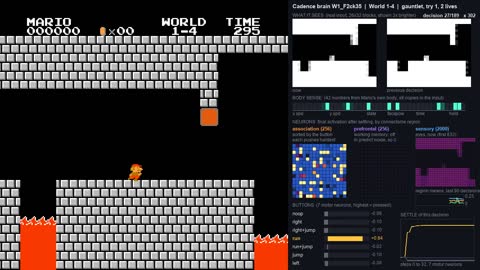
Brain scope
Scrub through a solo run and watch the brain's real neuron activity, or poke it to see what part of the screen each move depended on.
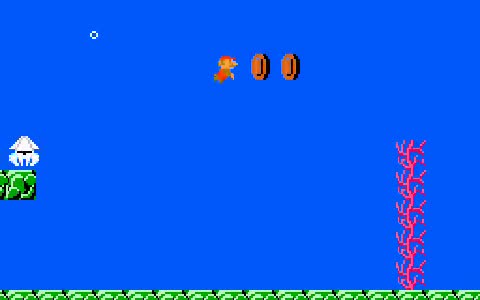
Level by level
The in-order run, first-sight tests, per-level tables and more clips.
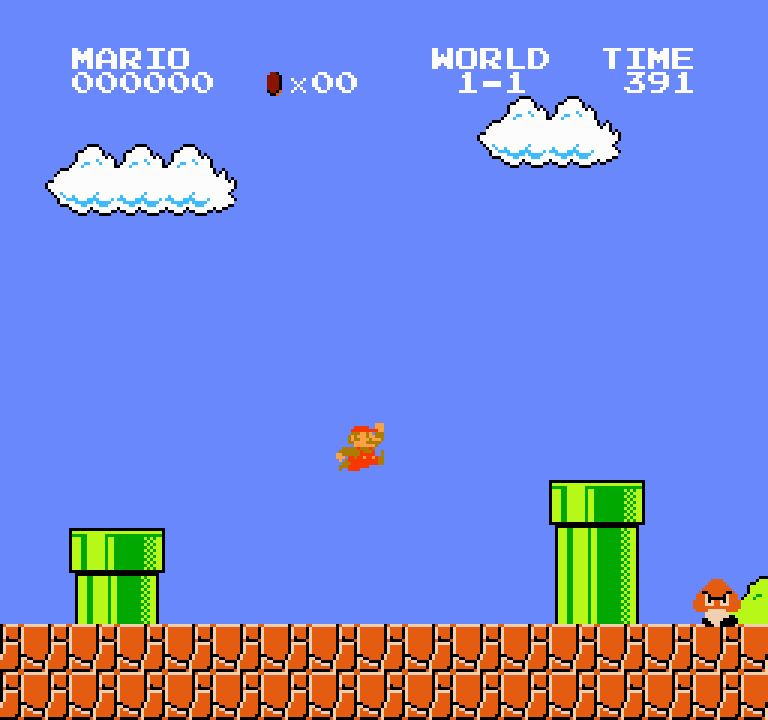
The first 1-1 run
10/28-29: the older brain's replay, learning curve and rescued runs.
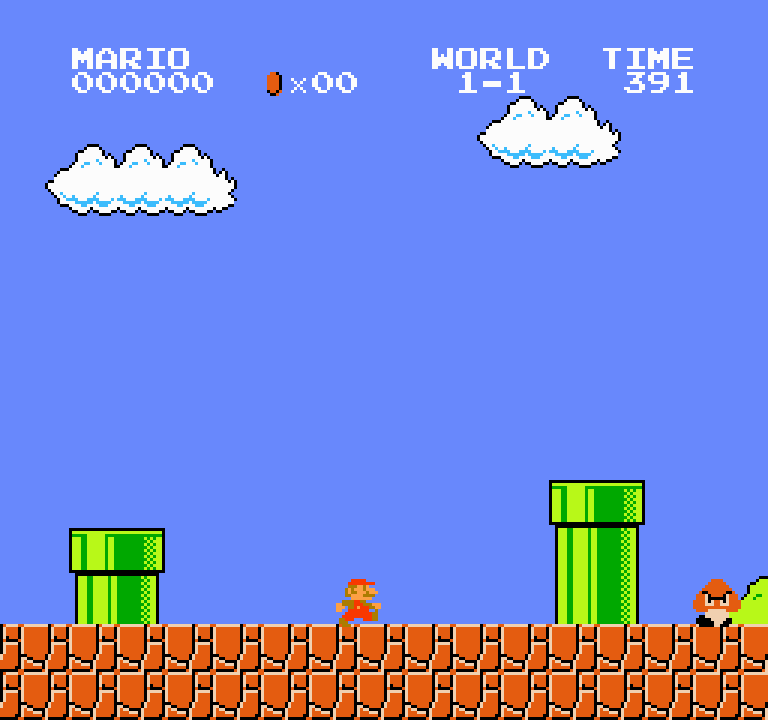
Watch the first run
The same older run as plain video: alone, and with coach rescues.